Court Cleaning Chemicals for Pickleball Facilities: What’s Safe, What’s Risky, and a Simple Approved Routine

Court Cleaning Chemicals for Pickleball Facilities: What’s Safe, What’s Risky, and a Simple Approved Routine
The quickest way to damage a great court: the wrong “miracle cleaner”
Most court damage doesn’t come from one dramatic mistake. It comes from a well-meaning staff member grabbing a strong cleaner to “really get it clean,” and repeating that choice week after week.
If you run a pickleball facility, you want two things at the same time:
- courts that look and feel premium (traction, consistency, cleanliness)
= a routine that won’t shorten the life of your acrylic surface system
Surface care guidance from manufacturers and sports surface organizations repeatedly emphasizes the basics: remove debris first, use gentle cleaning methods (often mild detergent), and rinse thoroughly. This post turns that into an operator-friendly system your team can follow without guessing.
Your “court-safe chemical” philosophy (simple and enforceable)
Before we talk products, lock in the rule set:
Court-safe rules (print these in your janitorial closet)
- Start with dry cleaning: blow/sweep first so you’re not grinding grit into the surface.
= Use mild detergent as the default: for routine cleaning and spot spills, mild detergent with soft-bristled tools is a common recommended approach.
- Rinse thoroughly: leftover residue can attract dirt and create a slick “film” feeling.
- Escalate slowly: repeat a mild process before reaching for stronger chemicals.
- Don’t improvise: if it’s not on your “approved list,” it doesn’t go on courts.
Why this matters: your goal is consistent results across staff shifts. A chemical policy removes the guesswork that leads to damage.
What’s generally safe vs risky (in practical terms)
I’m not going to pretend every court surface is identical—manufacturers can have specific guidance. But across major sport-surface maintenance resources, the “safe defaults” are consistent: mild cleaning, soft tools, rinse, and caution with aggressive methods.
Generally safe defaults (for routine use)
Mild detergent + water
- Works for: most spills, light grime, tracked-in dirt
- Use with: soft brush or microfiber, then rinse
Water + mechanical removal (blow/sweep/microfiber)
- Works for: dust, grit, leaf fragments, early buildup
- Key: do it often enough that “deep clean” becomes rare
Higher-risk category (use carefully or only with manufacturer approval)
Harsh/unknown chemicals
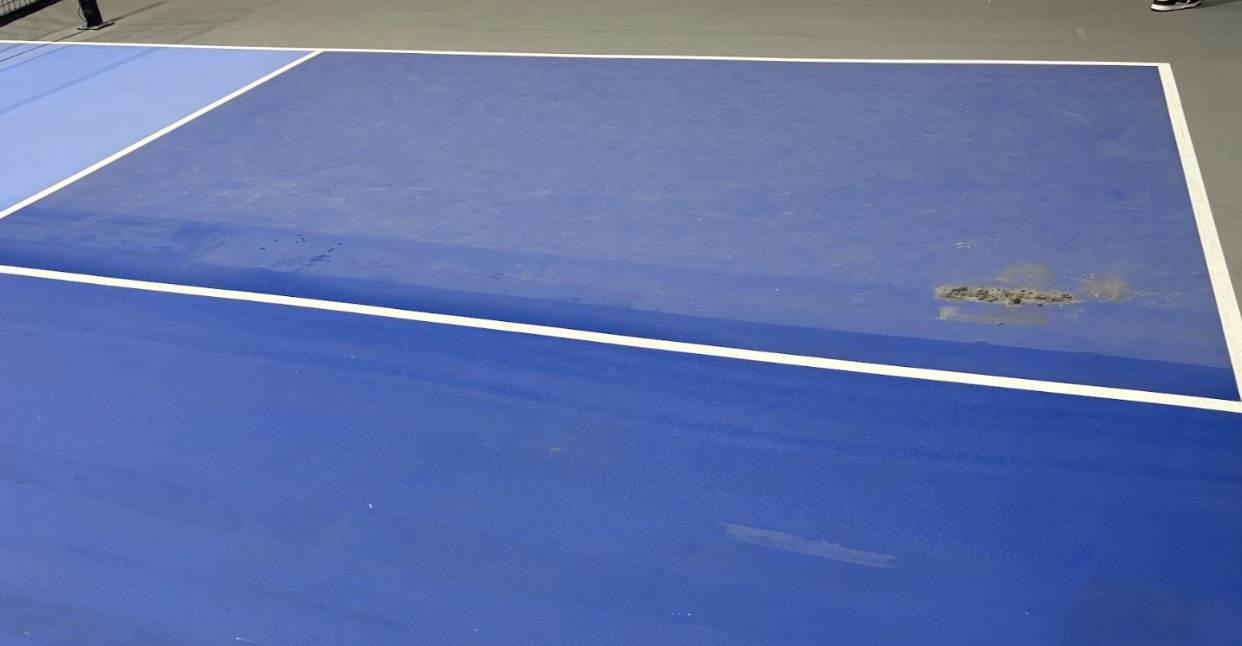
- Risk: discoloration, surface degradation, residue that changes traction
- Operator move: ban “mystery cleaners” and keep a short approved list
Aggressive pressure washing
- Risk: surface damage if used too aggressively
- Manufacturer guidance treats pressure washing as something to do carefully and appropriately—not as a default stain-removal tool
Bottom line: if staff are reaching for “strong stuff,” it usually means your routine needs better frequency and speed, not higher chemical intensity.
The “Approved Routine” your staff can execute (daily/weekly/monthly)
Here’s the repeatable routine that prevents chemical improvisation.
Daily (peak days): the 90-second spill + film prevention routine
Goal: stop sticky residue and grit from becoming a traction complaint.
- Dry pass first (30 seconds): blow/sweep gate zones + high-traffic lanes.
- Spill rule (30 seconds): if it’s sticky, clean it now with mild detergent + soft brush.
- Rinse/wipe (30 seconds): rinse thoroughly or wipe with damp microfiber if a full rinse isn’t possible immediately.
Non-negotiable: no spill gets “saved for later.” Later becomes stains + film.
Weekly: the “whole court but gentle” clean
Goal: reset the baseline cleanliness without grinding grit in.
- Full sweep/power blow (remove grit before it becomes abrasion).
- Spot-clean recurring zones:
gate zones
bench/bag areas
corners and fence edges
Mild detergent solution + soft-bristle tool, then rinse thoroughly.
Monthly: rotate deeper attention without making it a nightmare
Goal: prevent “problem zones” from slowly becoming permanent.
- Choose 2–3 courts per week (rotate through the facility).
- Do a more thorough mild-detergent cleaning on:
gate areas
shaded corners
baseline/kitchen movement lanes
Log recurring trouble spots for maintenance planning.
Common chemical mistakes (and the fixes)
Mistake 1: “Stronger cleaner = faster.”
- Fix: stronger chemicals often create new issues (residue, discoloration, traction changes). Repeat mild detergent cleaning and increase frequency
Mistake 2: Skipping the dry pass.
- Fix: always remove debris first—wet cleaning on top of grit is basically sandpaper.
Mistake 3: Not rinsing thoroughly.
- Fix: detergent residue can attract dirt. Build “rinse” into the SOP as a required step.
Mistake 4: Treating pressure washing like a reset button.
- Fix: use it cautiously and appropriately. Don’t substitute it for routine maintenance.
Quick Answers (For Busy Owners)
Q: What’s the safest default cleaner for pickleball courts?
A: Mild detergent + water with soft-bristled tools, then rinse thoroughly.
Q: Should we use harsh chemicals to remove sticky residue?
A: Usually no—increase frequency and use mild detergent + soft brush + thorough rinse first (ASBA + USA Pickleball, 2023).
Q: Why do courts feel “slick” even when they look clean?
A: Often a thin residue film or fine dust layer—rinsing well and doing frequent dry passes helps.
Q: Is pressure washing safe?
A: It can be, but only when done carefully and appropriately—don’t treat it as a default stain-removal method (California Sports Surfaces, 2022).
Q: What’s the #1 habit that prevents chemical overuse?
A: A strict “spill rule” with a courtside mild-detergent kit.
Q: How do we keep staff from improvising?
A: Create a short approved list + a simple SOP posted where supplies are stored.
Q: What should we do if stains keep returning in the same area?
A: Treat it as a system issue: gate traffic, spill patterns, shade/dampness, or drainage—not a “stronger chemical” issue (SportMaster, 2024).